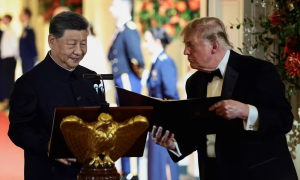
On a Maryland runway that usually belongs to Air Force One, protocol, and the quiet machinery of American power, President Trump has chosen to stand in public and wait. Joint Base Andrews is not the South Lawn. It is concrete, wind, engines, and cameras. By walking onto that tarmac to receive President Xi Jinping of China, President Donald Trump is not merely greeting a guest. He is staging a sentence the world is meant to read in one glance: the two largest powers have decided, at least for a season, to look like a pair.
The red carpet, the honor guard, the planned flyover of a B-2 and F-22s the following day, the first ladies in matching ceremonial orbit, the Silicon Valley guest list at the state dinner—these are not decorations. They are real subtle diplomacy. Washington almost never does this. American presidents receive foreign leaders at the White House. The rare modern exceptions of a sitting president going to Andrews were reserved for Popes, not for a strategic competitor. In Trump’s second term, this is the first airport reception of a foreign head of state.
The exception is the message.
The comparison with Beijing last May is deliberate and incomplete. When Trump landed at Capital Airport, Xi did not come to the runway. Vice President Han Zheng did, with flags, a band, and the calibrated warmth of a system that treats the airport as a station for deputies, not for the paramount leader. That was Chinese protocol, not an insult. Trump’s reply is American improvisation: he will do what Xi would not. The imbalance is the spectacle. The cameras will not linger on the difference in constitutional custom. They will linger on the handshake at the foot of the stairs.
From that image Trump wants a larger story to grow—what an older generation of commentators once called ‘Chimerica’ (a term coined by British historian Niall Ferguson), now refurbished as a working duo rather than a marriage of factories and Treasury bills. The claim implicit in the staging is simple and vast: if Washington and Beijing stand together on the same strip of asphalt, then the other crises of the age become solvable in principle. Iran and the blocked arteries of the Gulf. Ukraine and the frozen attrition of Europe’s war. Tariffs, rare earths, chips, and the unsettled rules of artificial intelligence. The tarmac is being asked to carry the weight of a two-power system.
That is an extraordinary burden for a greeting. It is also classic Trump: compress a strategic argument into a picture, then let the picture do the arguing.
What the picture is supposed to say to China. To Beijing the gesture says: we will treat you as a peer in the only language that travels without translation—rank, ceremony, and time. A U.S. president who leaves the White House to meet an arriving aircraft is conceding something Washington has long refused to concede in form, even when it conceded it in fact: that the relationship is no longer one of tutor and pupil, sheriff and rising merchant. It is a meeting of two centers. The invitation Xi accepted in May is being repaid with interest. The “milestone of historic significance” Chinese spokesmen have already named is being given an American set.
There is flattery in that, and there is pressure. Flattery, because status is a Chinese diplomatic currency as real as any memorandum on soybeans or Boeing frames. Pressure, because a public elevation raises the cost of walking away empty. If the world has been told that a new condominium is forming, then a sour communiqué the next evening looks like a failure of the condominium, not merely of a working lunch.
What the picture is supposed to say to everyone else. To allies, rivals, and markets the same image says something colder. Europe is fighting in Ukraine with American munitions and without an American settlement. The Middle East is still living inside the aftershocks of a war that closed waterways and repriced risk. Middle powers have spent years hedging between Washington and Beijing. An American president who greets Xi as if the two of them can close the book on those files is telling those audiences that the decisive table has two chairs.
This is why the protocol is “subject to different interpretation,” as any honest dispatch must admit. One reading is restoration: two adults agreeing to manage a dangerous world. Another is abdication: Washington advertising that it cannot finish its wars or discipline its supply chains without a partner it spent a decade calling a rival. A third is theater without transfer—the red carpet as a substitute for a text.
The disclaimer is not a cynical decoration. It is the adult clause. Trump may be using the tarmac as a beautiful trap. The United States wants Chinese help, or at least Chinese restraint, in the Iranian file: oil flows, diplomatic cover, the difference between a freeze and an afterlife of the war. It wants Beijing’s weight on Moscow to be something other than a silent subsidy. It wants Chinese capital and talent inside an AI conversation that does not become two sealed empires shouting across an export-control wall. A runway handshake is a cheap way to create the mood in which those tasks can be made without looking like begging.
Deception, in this register, does not mean a secret letter in the lining of a coat. It means sequencing. First the world sees equality. Then the ledger appears: purchases, tariff corridors, language on Taiwan that can be read two ways, a sentence on energy that can be sold in both capitals. If China “helps Uncle Sam out of the quagmire,” the spectacle will be remembered as statesmanship. If China pockets the honor and yields little, the same spectacle will be remembered as a man who confused arrival honors with leverage.
Xi knows this game. He is unlikely to confuse a carpet with a concession. The question is whether Trump is confusing it either, or whether he is merely willing to let others confuse it long enough to move a negotiation.
Or could it be a reverse déjà vu? The historical rhyme being offered is Nixon in 1972—the week that broke a bipolar world and introduced a triangular one. That trip was a secret architecture made public: Both China and the U.S. against the Soviet Union, and China badly against isolation, a handshake that rearranged maps. What Trump is attempting is the inversion. Nixon went to China as the weaker party in the room of Chinese civilizational pride and as the stronger party in the room of global military power. He needed the split in the communist world. Mao needed the American card against Moscow.
Today the geometry is different. There is no third pole of equal weight in the same way. Russia is a co-belligerent and a problem, not a mirror superpower. Europe is a coalition, not a pole. The “days that changed the balance of power” in 1972 created space. The tarmac in 2026 is being asked to close space—to suggest that the two remaining comprehensive powers can jointly liquidate the problems their rivalry helped inflame. That is not a triangle. It is a claim of condominium. Whether it is a new ‘Chimerica’ or only the costume of one will be settled in the talks, not on the concrete.
Nixon’s opening was also theater. The banquets, the Great Wall, the toasts—they were the visible half of a structure built in Warsaw and Islamabad and on yellow pads.
And yet optics are not nothing. In a world that reads power through pictures before it reads annexes, the first American president in this era to greet a Chinese leader on a Washington runway has already altered the available interpretations of the relationship. Allies must now argue against an image, not only against a briefing. Beijing must decide whether to cash the honor or match it with movement. Markets will price the handshake faster than they price a working group on rare earths.
That is the success already banked, whatever the motives. Trump has forced the world to watch a big-power game in the old style—leaders, carpets, aircraft, the pretense that history can be rearranged by two men standing in the blast of jet wash. It may be a partnership. It may be a ploy. It may be both, which is how most durable diplomacy actually works. The runway will not tell us which. It will only tell us that Trump wants the world to believe, for an afternoon, that ‘Chimerica’ had a gate, a guard, and a name.

在馬裡蘭州那條通常屬於「空軍一號」、禮賓規制以及美國權力靜默運作的跑道上,川普總統選擇公開站立,靜候來賓。安德魯斯聯合基地不同於白宮南草坪;那裡只有混凝土、勁風、引擎轟鳴和長槍短砲。川普總統步入停機坪迎接中國國家主席習近平,此舉不僅僅是為了接待一位訪客。他正在向世界展示一個一目了然的訊號:這兩個超級大國已決定──至少在現階段──要呈現出一種並肩同行的姿態。
紅地毯、儀仗隊、隔天安排的B-2轟炸機與F-22戰鬥機編隊飛越致意、兩位「第一夫人」在禮賓場合的同步亮相、國宴上矽谷精英雲集的賓客名單——這些絕非僅僅是裝點門面,而是極具巧思的外交安排。華盛頓向來極少採取這種接待方式;通常,美國總統是在白宮接待外國領導人的。在現代歷史上,現任總統親赴安德魯斯基地迎接外賓的先例寥寥無幾,且此前多是為教皇等特殊人物破例,而非針對戰略競爭對手。這是川普第二任期內首次在機場迎接外國元首。
「例外」在於這次的會面安排
將此訪問與去年5月北京之行所做的對比,既是有意為之,又不盡全面。當時川普抵達首都機場,習近平並未親赴停機坪迎接;出面的是副主席韓正,現場有旗幟、有樂隊,還有一種「拿捏得當」的熱情——這種禮遇體現了該體制的慣例:機場通常是接待副職官員的場所,而非最高領導人親自迎賓之地。那屬於中國的禮賓規範,絕非有意怠慢。而川普的回應則帶有典型的美式即興風格:他要做出習近平當年未曾做出的舉動。這種不對稱本身就是一場引人注目的「奇觀」。鏡頭不會聚焦在憲制慣例上的差異,而是定格在舷梯下那次握手的瞬間。
川普希望藉此畫面衍生出更宏大的敘事——即老一輩評論員曾稱之為「中美國」(Chimerica,由英國歷史學家尼爾·弗格森首創)的概念,如今這一概念被賦予了新意,不再僅僅是「工廠與國債」的聯姻,而是轉變為一種務實的雙邊協作關係。這一幕佈置所隱含的論點既簡單又宏大:只要華盛頓與北京能並肩立於同一片停機坪上,那麼當今時代的其他種種危機在原則上便都有了解決的可能。無論是伊朗問題與波斯灣受阻的航道,烏克蘭局勢與歐洲戰事陷入的僵持消耗,或是關稅、稀土、晶片以及尚未定型的人工智慧規則——這片停機坪正承載著維繫大國雙極體系的重任。
對於一句問候語而言,這承載了非同尋常的重任。這也是典型的川普風格:將策略論點濃縮為一幅畫面,然後讓畫面本身傳達主張。
這張照片意在向中國傳達某種訊息。對北京而言,這一姿態表明:我們將以一種無需翻譯便能通行的「語言」——即地位、禮儀與時間——來視你為平等的伙伴。美國總統走出白宮、親自迎接抵達的專機,這一舉動意味著華盛頓承認了某種長期以來在形式上不願承認、即便在事實上已然接受的事實:即雙方關係已不再是“導師與學生”或“治安官與新興商人”那樣的關係,而是一場兩大權力中心之間的會晤。習近平主席5月接受的邀請,如今正得到加倍的回饋。中國發言人已將此次會晤定性為“具有歷史意義的里程碑”,而美方也正以相應的規格與安排來呼應這一評價。
這其中既有恭維,也有壓力。說它是恭維,是因為「地位」是中國外交中的一種籌碼,其分量與關於大豆或波音飛機的任何備忘錄別無二致。說它是壓力,是因為公開提升規格會增加“空手而歸”的代價:既然全世界都已獲悉雙方正醞釀建立某種“夥伴關係”,那麼次日傍晚若發布一份不歡而散的公報,便會被視為這種夥伴關係的破裂,而不僅僅是一次工作午餐的失敗。
這張照片意在向外界傳達某種訊息,但對於盟友、競爭對手及市場而言,同一畫面所釋放的訊號則更為冷峻。歐洲正利用美國的彈藥在烏克蘭作戰,卻未能獲得美國的解決方案;中東地區仍深受那場導致航道關閉並重塑風險定價的戰爭的餘波影響;中等強國多年來一直在華盛頓與北京之間尋求平衡。而當美國總統以一種彷彿兩人能徹底了結這些棘手議題的姿態會見習近平,他實際上是在向各方表明:決定局勢走向的談判桌上,只有兩個席位。
正因如此,正如任何坦誠的報道都必須承認的那樣,該協議「存在多種解讀空間」。一種解讀視其為「重振」:即兩位成年人達成共識,聯手應對這個充滿危險的世界。另一種解讀則視其為「退讓」:華盛頓向外界表明,若沒有那個曾被其視為對手長達十年的伙伴相助,它便無法結束戰事或管控供應鏈。還有一種解讀認為,這不過是一場徒有其表的「作秀」——即用紅地毯儀式掩蓋了實質協議文本的缺失。
這份免責聲明並非冷酷的政治裝飾,而是一個理性的成熟條款。川普可能正將這塊機場停機坪,當成一個包裝精美的陷阱。 美國在伊朗議題上需要中國的協助,或者至少需要中國保持克制——這牽涉到原油流動、外交掩護,以及戰爭究竟會就此凍結,還是會繼續延續下去的本質差異。美國希望北京對莫斯科施加的影響力,不再只是某種暗中的默許與資助;美國也希望在人工智慧(AI)的對話中,納入中國的資金與人才,而不是讓兩國演變成在出口管制牆的兩端、彼此叫囂的封閉帝國。在跑道上的一次握手,是一種極低成本的手段,藉此營造出雙方能著手處理上述棘手任務的氛圍,同時又不會讓美國顯得是在向對方乞求。
在這裏,所謂的「欺敵」並不是指藏在衣服襯裡之中的機密信件,而是指鋪陳的順序。世界首先看到的會是對等。接著,真正的帳本才會顯現:各項採購、關稅走廊、對台灣問題可雙重解讀的措辭,以及在兩個大國首都都能各取所需、各自交代的一句話。如果中國「幫助山姆大叔走出泥淖」,這一幕將作為展現政治家風範的經典而被載入史冊;但如果中國收下了這份榮譽,實際上卻幾乎不做出任何讓步,那麼同樣的這一幕,在歷史上將會被記憶為:一個錯把「接機的歡迎禮遇」當作「談判籌碼」的人。
習近平非常懂得這種政治賽局。他不太可能把腳下的紅地毯,誤當成對方實質的讓步。現在的關鍵問題在於:川普自己是否也分得清這兩者的差別? 抑或,他只是刻意放任外界去混淆這兩者,只要時間長到足以推進一場談判,他就達到了目的。
或者,這有沒有可能是一場反向的既視感?歷史在此時提供的對應旋律,是 1972 年的尼克森訪華——那一個打破了雙極世界、並開啟三國鼎立格局的歷史性一週。那次出訪是一場揭曉於世人面前的秘密戰略架構:中美雙方聯手對抗蘇聯,而當時深陷孤立的中國則拼死一搏以求突圍,那一記握手重新排列了世界地圖。而川普現在所嘗試的,恰恰是當年的反轉。當年,尼克森踏上中國領土時,若在中國「文明自豪感」的內室裡,美國是較為弱勢的一方;但在全球「軍事強權」的殿堂裡,美國則是強者。尼克森當時需要共產主義世界發生分裂,而毛澤東則需要借助「美國牌」來抗衡莫斯科。
時至今日,國際政治的幾何結構已完全不同。這世上再也沒有一個實力對等的「第三極」存在。
俄羅斯現在是一個與他人聯手挑起衝突的交戰國、一個棘手的麻煩,而非一個實力旗鼓相當的鏡像超級大國。歐洲則是一個利益聯盟,算不上獨立的一極。1972 年那些「改變權力平衡的日子」創造了戰略緩衝空間;而 2026 年的這塊機場停機坪,肩負的任務卻是收緊空間——它試圖向世人表明,這世界上僅存的兩個「全方位地緣政治強權」,能夠共同解決兩國因彼此對抗而推波助瀾、進而引燃的全球問題。這絕非三國鼎立的三角格局,而是一種雙頭協管(Condominium)的主張。究竟這會催生出一個全新的「中美國(Chimerica)」,還僅僅只是披著這層虛華的外衣?這一切將在接下來的談判桌上見真章,而不是在這片水泥跑道上。
當年尼克森的破冰之旅,同樣也是一場政治劇場。那些國宴、萬里長城之行、以及觥籌交錯間的祝酒——這些都只不過是一座宏偉架構中,最顯而易見的外在後半部;而這座架構真正的根基,早就在華沙、伊斯蘭馬巴德,以及一張張黃色法律便條紙上默默搭建完成了。
然而,這種視覺上的政治呈現(Optics)絕非毫無意義。在一個習慣「先看照片解讀權力,後看協議附件」的世界裡,作為這個時代首位在華盛頓機場跑道上親自迎接中國領導人的美國總統,川普此舉本身,就已經徹底改變了世人對美中關係的既定解讀。現在,盟友們必須去對抗這張「照片」所帶來的政治衝擊,而不再僅僅是對抗一份雙邊簡報。北京方面也必須做出抉擇:究竟是要直接將這份大國禮遇「變現」收下,還是要拿出實質的讓步行動來與之對等呼應。甚至連金融市場對這記「握手」的利多定價,都會遠遠快過他們對稀土工作小組實質協議的估值。
不論兩人的真實動機為何,這都已經是川普裝進口袋、落袋為安的成功了。川普成功迫使這個世界去觀看一場古典風格的大國博弈——這裡有領袖、有紅地毯、有巨型專機,以及一種「兩個人站在飛機噴射氣流的餘溫中,就能重新排列歷史」的宏大假象。這可能是一場真誠的夥伴關係,也可能是一場政治權謀,抑或兩者皆是——而這恰恰是大多數持久的外交關係實際上運作的常態。這條機場跑道並不會告訴我們答案。它唯一告訴我們的是:川普要讓全世界在今天下午相信,「中美國(Chimerica)」這個概念,真的有了一座大門、一個守衛,以及一個確切的名字。
♦ 2026/9/28。若有侵害著作權,請速告知,我們將盡速移除 ♦